

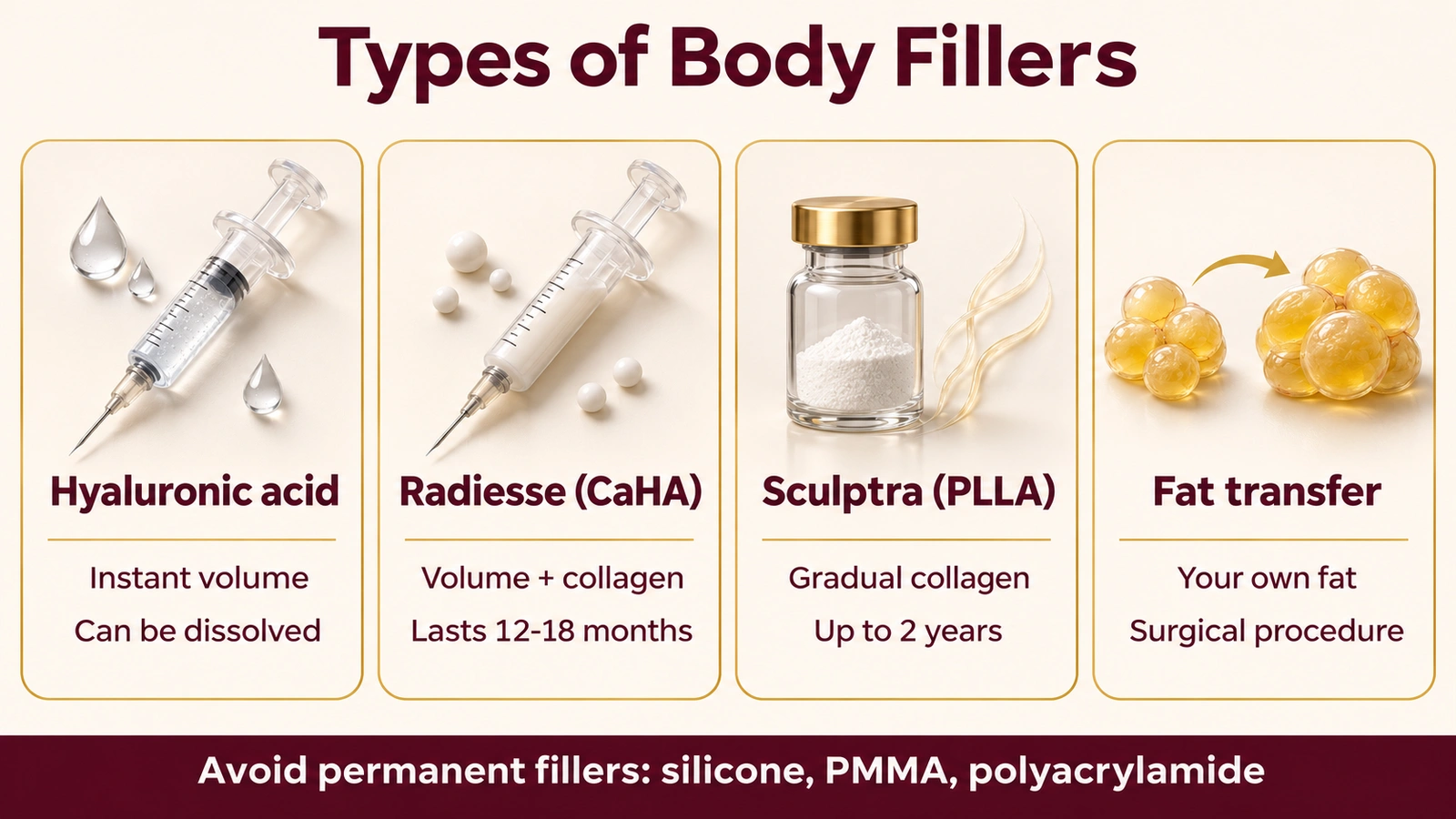
There are four main types of body fillers: hyaluronic acid (HA) fillers, calcium hydroxylapatite (CaHA) such as Radiesse, poly-L-lactic acid (PLLA) such as Sculptra, and fat transfer. HA is the only type that adds volume straight away and can be dissolved if needed. CaHA and PLLA work more slowly by stimulating your own collagen, and fat transfer is a surgical procedure. Permanent fillers such as silicone should be avoided.
Body Filler Types Compared
| Type | How it works | Results show | Lasts | Reversible? |
|---|---|---|---|---|
| Hyaluronic acid (HA) | Gel fills the area directly | Immediately | About 12 to 18 months | Yes, with hyaluronidase |
| Calcium hydroxylapatite (Radiesse) | Microspheres support tissue and stimulate collagen | Partly at once, then over weeks | About 12 to 18 months | No |
| Poly-L-lactic acid (Sculptra) | Stimulates collagen over several sessions | Gradually, over 2 to 3 months | Up to 2 years or more | No |
| Fat transfer | Your own fat is moved by liposuction | After swelling settles | Long-lasting for the fat that survives | No (surgical) |
Hyaluronic Acid (HA) Body Fillers
Hyaluronic acid is a molecule your body already makes. It binds water, so an HA gel adds volume and hydration wherever it is placed. Fillers made for the body, such as Hyacorp, are more cross-linked and thicker than facial fillers, which helps them hold their shape in larger areas like the buttocks, hips and hip dips.
The doctor injects the gel into the deep fatty layer with a blunt cannula, and the result is visible as soon as the treatment ends. Your body gradually breaks the HA down, so results usually last 12 to 18 months. The main advantage is control: volume can be added in steps, and if the result is uneven or a problem occurs, the gel can be dissolved with an enzyme called hyaluronidase.
HA fillers suit people who want a moderate, immediate change and prefer a temporary result. They are the type used for body fillers at Charisma.
Calcium Hydroxylapatite (Radiesse)
Calcium hydroxylapatite is a mineral that occurs naturally in bone. In Radiesse, tiny CaHA microspheres sit in a gel carrier. The gel gives some immediate support, then breaks down while the microspheres stimulate your own collagen around them. When diluted, Radiesse is also used to firm loose, crepey skin on the arms, abdomen, décolletage and buttocks.
Results build over several weeks and usually last 12 to 18 months. Because Radiesse cannot be dissolved like HA, it is placed carefully and is not used in every area. Read more about Radiesse injections.
Poly-L-Lactic Acid (Sculptra)
Poly-L-lactic acid is a biodegradable material that the body has long used in dissolvable stitches. Sculptra does not fill an area on the day. Instead, it triggers collagen production gradually, so volume and firmness improve over two to three months, usually after two or three sessions spaced a few weeks apart.
On the body, Sculptra is used for buttock volume and lift, cellulite-related laxity and loose skin. Results can last two years or more. It suits patients who want a gradual, natural change and do not mind waiting for it. Read more about Sculptra and other biostimulators.
Fat Transfer
Fat transfer, known for the buttocks as a Brazilian butt lift (BBL), removes fat from areas such as the abdomen or flanks with liposuction, purifies it and injects it into the area you want to enlarge. Part of the transferred fat is reabsorbed in the first months; the fat that survives behaves like normal fat and lasts long-term.
Fat transfer can create a larger change than fillers and uses your own tissue, but it is surgery. It needs anaesthesia, several weeks of recovery and a qualified plastic surgeon, and it carries surgical risks that injectable fillers do not.
Permanent Fillers to Avoid
Liquid silicone, PMMA (polymethyl methacrylate) and polyacrylamide gel stay in the body permanently and cannot be dissolved. Years after injection they can cause hard lumps, chronic inflammation, infection and migration of the product to other areas, and removing them often needs surgery. Some of these products are no longer used by reputable clinics for this reason. Never agree to a body filler if the clinic cannot tell you the product’s name or show you the original, sealed packaging.
What Is the Best Filler for the Body?
There is no single best filler; the right type depends on your goal:
- Immediate, moderate volume with the option to adjust: hyaluronic acid filler.
- Firmer skin and gradual, natural-looking volume: Sculptra or Radiesse.
- A large change in size using your own tissue: fat transfer.
- Firmer, stronger muscles rather than added volume: a muscle-building device such as EMSCULPT NEO.
Some patients combine options, for example HA filler for shape with a biostimulator for skin quality. A doctor’s assessment of your anatomy, skin and goals decides which approach fits.
Are Body Fillers Safe?
Body fillers are considered safe when an approved product is injected by a trained doctor in a clinic. Common side effects are swelling, bruising and tenderness for one to two weeks. Less common problems include lumps, uneven results, infection and product migration, and serious complications such as a blocked blood vessel are rare but need urgent treatment. Before any body filler, ask:
- What is the product’s name, and is it approved in the UAE?
- Is it hyaluronic acid, and can it be dissolved if needed?
- Who will inject it, and what is their medical licence?
- How many ml do I need, and what is the total price?
If you are considering body fillers in Dubai or Abu Dhabi, a consultation with a Charisma doctor is free and will tell you which type suits your body and goals. See body fillers in Dubai and Abu Dhabi for areas, treatment steps and prices.